tag:theology.nd.edu,2005:/newstag:theology.nd.edu,2005:/latestDepartment of Theology | News2026-09-29T11:24:00-04:00Explore theology at Notre Dame: blending faith and reason. Apply Catholic tradition to today's questions, seeking deeper understanding.tag:theology.nd.edu,2005:News/1857512026-09-29T11:24:00-04:002026-09-29T11:24:45-04:00Daniel Machiela appointed as Visiting Fellow at the University of Cambridge for Fall Term
Daniel Machiela, Professor in the Department of Theology, has been elected the Bleehen Visiting Fellow at St. John's College, University of Cambridge, for Michaelmas Term, 2026. While at Cambridge, Professor Machiela will be finishing a book project related to his research on the Aramaic Dead Sea Scrolls. He will also begin a commentary project on the Genesis Apocryphon (1Q20), one of the first Dead Sea Scrolls discovered by Bedouin shepherds along the coast of the Dead Sea in 1947.
]]>
Theology Departmenttag:theology.nd.edu,2005:News/1857112026-09-23T14:15:00-04:002026-09-23T14:15:10-04:00Notre Dame theologian John Cavadini to receive 2026 Ratzinger PrizeJohn Cavadini, professor of theology (Photo by Matt Cashore/University of Notre Dame)
John Cavadini, professor and director of the doctoral program in the Department of Theology at the University of Notre Dame, will receive the 2026 Ratzinger Prize in Theology, widely regarded as the most prestigious award in the field.
Pope Leo XIV will present the prize to Cavadini at the Vatican Apostolic Palace on December 19.
Cavadini is the third theologian from Notre Dame to win the Ratzinger Prize, following professors emeriti Cyril O’Regan (who received the award from Pope Francis in 2024) and Rev. Brian E. Daley, S.J. (honored by Pope Benedict XVI in 2012).
“I am very humbled to receive this award, especially after two truly giants in our field and members of our department have received it,” Cavadini said. “I have sought to live out my vocation as a theologian following the example of Origen of Alexandria, a third-century theologian, who repeatedly declared that he wished to be a vir ecclesiasticus, a man of the Church. At Notre Dame, I have been able to live out my vocation as a man of the Church and, at the same time, as a man of the academy.”
Since 2011, the Ratzinger Prize has been annually awarded to scholars, both Catholic and of other faiths, who have made significant contributions to the study of theology in fields such as philosophy, law, and sociology. In recent years, the scope has also expanded to honor musicians, architects, and sculptors.
In announcing the award, the Vatican recognized Cavadini for his work in patristic theology, with a focus on St. Augustine.
“Cavadini is highly regarded for the rigor of his theological publications, his commitment and zeal in university teaching, his academic expertise, his pastoral passion, and his lifelong service to the Church,” said Roberto Regoli, president of the Joseph Ratzinger-Benedict XVI Vatican Foundation.
In addition to his work on Augustine, Cavadini’s research focuses on early medieval theology and the history of biblical and patristic exegesis. His scholarship includes books such as Visioning Augustine (John Wiley & Sons Ltd.: 2019), more than 50 articles in refereed journals or edited collections, and a forthcoming work titled “Augustine’s On the Trinity: A Companion.”
Cavadini received his bachelor’s degree from Wesleyan University, a master’s degree from Marquette University, and a doctorate from Yale University. He came to Notre Dame in 1990 and has since served in a number of administrative and scholarly positions, including chairing the theology department from 1997 to 2010 and directing the McGrath Institute for Church Life for 26 years. In 2009, Cavadini was appointed by Pope Benedict XVI to a five-year term on the International Theological Commission, and since 2003, he has been a consultant for the U.S. Conference of Catholic Bishops’ Committee on Doctrine.
In addition to his leadership appointments, he has taught both undergraduate and graduate courses and directed nearly 40 dissertations.
“I would hope that honored with this award are all of my students — past and present and future, graduate and undergraduate — all of my colleagues in the Department of Theology to whom I owe so much, and all of the faculty and staff of the McGrath Institute for Church Life, of whose gifts I have been the beneficiary for the last 26 years,” Cavadini said. “Most of all, perhaps, I hope this award redounds, with gratitude, to the credit of Our Lady, the patroness of our University, under whose protection we have flourished for the last 183 years, and may it be so for the next 183 years.”
Contact: Erin Blasko, director of media engagement, 574-631-4127, eblasko@nd.edu
Originally published by Adah McMillan at news.nd.edu on September 23, 2026.
]]>
Adah McMillantag:theology.nd.edu,2005:News/1854892026-08-31T11:23:00-04:002026-09-14T11:23:22-04:00Two Notre Dame faculty members and University Trustee appointed by Pope Leo XIV as consultors to the Dicastery for Promoting Integral Human DevelopmentEmmanuel Katongole, Clemens Sedmak, and Kathryn “Katie” Koch have been appointed by Pope Leo XIV as consultors to the Dicastery for Promoting Integral Human Development.
On Tuesday, Aug. 18, Pope Leo XIV appointed two University of Notre Dame faculty members, Emmanuel Katongole and Clemens Sedmak, as consultors to the Dicastery for Promoting Integral Human Development. University Trustee Kathryn “Katie” Koch, president and CEO of TCW, a global investment management firm, was also named a consultor.
Katongole, a professor of theology and peace studies and director of the Ansari Institute for Global Engagement with Religion; Sedmak, a professor of social ethics and director of the Nanovic Institute for European Studies; and Koch are among 12 new consultors from around the globe — and the only three selected from within the United States. They have been appointed for a five-year term.
Consultors may be religious or laypeople and are chosen “from among the faithful who are distinguished by their expertise, proven ability, and prudence,” according to the Vatican’s announcement.
“These appointments are a tremendous honor not only for Emmanuel, Clemens, and Katie, but for the University as a whole,” said Notre Dame President Rev. Robert A. Dowd, C.S.C. “We congratulate them on their selection, and we are deeply grateful for the Holy Father’s recognition of their expertise and abiding commitment to the Church. We look forward to the ways their leadership and wisdom will guide the important work of the dicastery.”
Established by the late Pope Francis in 2016, the Dicastery for Promoting Integral Human Development supports the Church’s worldwide efforts in the areas of human dignity and human rights, economic justice, care for creation, migration, and displacement, as well as peace, conflict, and humanitarian crises.
Katongole, who came to Notre Dame in 2013, holds a joint appointment in the University’s College of Arts and Letters and Keough School of Global Affairs. A native of Kampala, Uganda, and a priest of the Kampala Archdiocese, he is the founder and president of Bethany Land Institute, a residential agricultural institute that works with young people to realize the vision, spirituality, and practice of Laudato si’ in Uganda. Before joining the Notre Dame faculty, he served as an associate professor of theology and world Christianity at Duke University and was a founding co-director of the Duke Center for Reconciliation. He earned a Bachelor of Divinity at the Pontifical University Urbaniana in Rome, as well as a master’s in religious studies and a doctoral degree in philosophy from the Catholic University of Louvain in Belgium.
Sedmak, a concurrent professor of theology, holds a joint appointment in Notre Dame’s Institute for Social Concerns and the Keough School. His research focuses on issues of poverty, justice, and the Catholic social tradition, as well as a collaboration with Notre Dame colleagues on the Church’s role in acclimating refugees into Italian society. A native Austrian, Sedmak holds a doctoral degree in theology from the Catholic Private University of Linz and doctoral degrees in philosophy and social theory from the University of Innsbruck. Prior to joining Notre Dame, Sedmak served as the F.D. Maurice Professor for Moral Theology and Social Theology at King’s College London. He also held multiple positions at the University of Salzburg and was president of the Institute for Advanced Studies in Social Ethics in Salzburg.
Koch, a Notre Dame alumna, was named a University Trustee in 2023. Prior to moving to TCW, she spent 20 years at Goldman Sachs in a variety of leadership positions, including chief investment officer of public equity. She graduated from Notre Dame in 2002 with a Bachelor of Arts in economics and English.
Originally published by Carrie Gates at news.nd.edu on August 20, 2026.
]]>
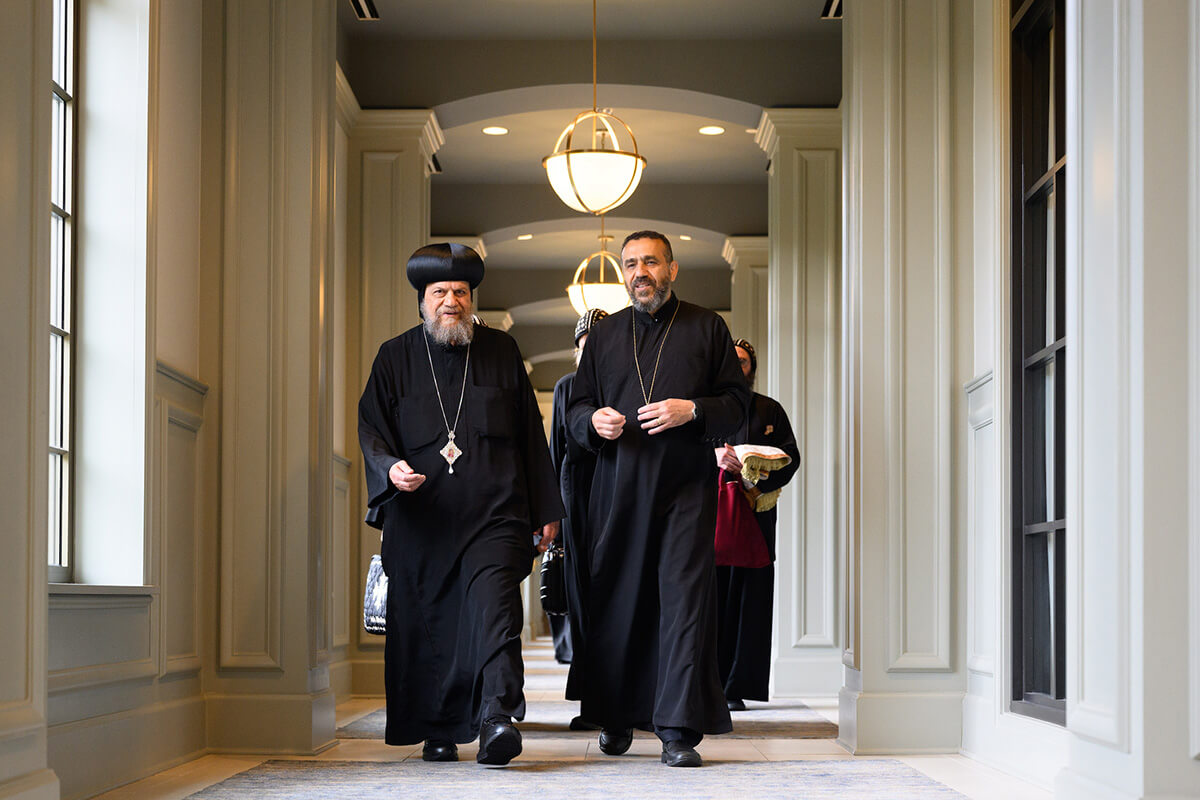
Carrie Gatestag:theology.nd.edu,2005:News/1854902026-08-31T10:23:00-04:002026-09-14T11:25:55-04:00Fulfilling an ecumenical mission: Notre Dame hosts U.S. Coptic bishops gathering for the first timeMetropolitan Serapion (left), the first hierarch and bishop of the Coptic Orthodox Diocese of Los Angeles, Southern California, and Hawaii, walks with Fr. Khaled Anatolios, the John A. O’Brien Professor in the Department of Theology, down a Morris Inn hallway. Metropolitan Serapion and 11 other Coptic bishops came to the University of Notre Dame to have their annual theological consultation. (Photo by Matt Cashore/University of Notre Dame)
Every year, the bishops of the Coptic Orthodox Church in North America meet for a consultation to discuss theological issues. This year, the University of Notre Dame hosted the discussion for the first time — a landmark moment in the history of Coptic and Catholic cooperation.
Gathering under the auspices of the Tantur Ecumenical Institute, the 12 visiting bishops spent two balmy days in mid-June on Notre Dame’s campus discussing the teachings of St. Athanasius of Alexandria, one of the greatest foundational figures in Christian tradition. During this time, they also held liturgical services in the Malloy Hall Chapel (with permission from Bishop Kevin C. Rhoades, Diocese of Fort Wayne-South Bend), witnessed fellow Coptic priest Fr. Arsany Paul defend his Ph.D. dissertation in theology, and met with Notre Dame President Rev. Robert A. Dowd, C.S.C.
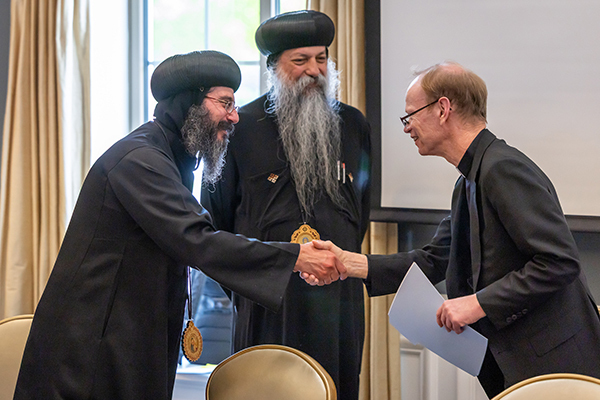
Bishop Gabriel (left), general bishop of New Jersey in the Coptic Orthodox Church, alongside Bishop David, bishop of New York and New England, shakes hands with Notre Dame President Rev. Robert A. Dowd, C.S.C. (Photo by Matt Cashore/University of Notre Dame)
“The Coptic bishops' decision to gather at a Catholic university is a sign that they respect Notre Dame and our academic community,” said Chuck Lamphier, executive director of Notre Dame's Office of Mission Engagement and Church Affairs. “Notre Dame certainly returns that respect and desire for friendship with the Coptic Orthodox Church. Jesus prayed that all Christians may be one, and Notre Dame takes seriously our responsibility to contribute to that desired unity.”
Fr. Khaled Anatolios, the John A. O’Brien Professor in the Department of Theology, led the discussion on St. Athanasius. A priest in the Byzantine Church and an expert in Patristic and Eastern Christianity, Anatolios is also a senior ecumenical fellow at the Tantur Ecumenical Institute. In this role, Anatolios coordinates scholarly activities that foster encounters across divides within Christianity, enabling Notre Dame to engage globally with the Christian tradition. He was invited to join the Coptic bishops for their theological consultation after presenting a lecture on St. Athanasius at a conference sponsored by the Coptic Orthodox Church last year.
“Everyone was impressed by Fr. Anatolios’ lecture and his knowledge,” said Metropolitan Serapion, the first hierarch and bishop of the Coptic Orthodox Diocese of Los Angeles, Southern California, and Hawaii. “So we wanted to come here to have our theological consultation with him, leading the discussion on St. Athanasius.”
Metropolitan Serapion leads the Coptic Divine Liturgy, celebrated in Malloy Hall Chapel on June 10, 2026, with permission from Bishop Kevin C. Rhoades, Diocese of Fort Wayne-South Bend. (Photo by Matt Cashore/University of Notre Dame)
At Notre Dame, the bishops discussed St. Athanasius’ theological personality and his writings on the Trinity, creation, Christology, salvation, and deification.
“I think it’s one of the best consultations we’ve had,” said Bishop Kyrillos, who serves as dean of the St. Athanasius and St. Cyril Theological School (ACTS) at Claremont University and obtained one of his doctoral degrees at Notre Dame. “It’s refreshing to just focus on St. Athanasius, and Notre Dame went above and beyond our expectations.”
Anatolios hopes for more collaborative opportunities between Notre Dame and the Coptic church, as well as other ecclesial traditions. Metropolitan Serapion said he is especially hopeful for academic partnerships between Notre Dame and ACTS.
Interreligious interactions like this visit are key to the work of the Tantur Ecumenical Institute, which serves as a place for ecumenical encounters and cooperation operated by Notre Dame. Though physically located in Jerusalem, its impact extends around the globe through academic events, other programs, and the works of Anatolios and other leaders.
“Catholicity entails a commitment to the unity and universality of the Church and, therefore, a commitment to ecumenism,” Anatolios said. “So for Notre Dame to fulfill its Catholic mission, it must fulfill its ecumenical mission.”
Originally published by Adah McMillan at al.nd.edu on July 01, 2026.
]]>
Adah McMillantag:theology.nd.edu,2005:News/1823762026-06-05T12:44:00-04:002026-08-04T10:17:34-04:00Fr. Emmanuel Katongole named director of Ansari Institute for Global Engagement with Religion
Fr. Emmanuel Katongole, professor of theology and peace studies in the Keough School of Global Affairs, has been appointed director of the Ansari Institute for Global Engagement with Religion, effective July 1, 2026.
“The Ansari Institute plays a vital role in advancing Notre Dame’s commitment to understanding religion as a force for good in global affairs,” said Mary Gallagher, the Marilyn Keough Dean of the Keough School. “Fr. Katongole brings extraordinary scholarly insight, global experience and a deep commitment to integral human development, a pillar of the Keough School’s research, teaching and policy work. His leadership will strengthen the institute’s mission and expand its global impact.”
A Catholic priest ordained by the Archdiocese of Kampala, Uganda, Katongole serves as a faculty fellow and advisory committee member for the Ansari Institute and is a core affiliated faculty member at the Kroc Institute for International Peace Studies. His research focuses on the Christian social imagination, integral ecology and faith-based approaches to justice and reconciliation.
An accomplished scholar, Katongole is the author of ten books exploring the intersections of faith, society and the environment in Africa. His book, Who Are My People? Love, Violence, and Christianity in Sub-Saharan Africa, received widespread recognition.
Katongole is also a co-founder and director of Bethany Land Institute in rural Uganda. At this institute, he advances the vision of "integral ecology” as proclaimed in Pope Francis’ 2015 encyclical Laudato Si.’ The institute offers a two-year program in regenerative agriculture and entrepreneurship aimed at addressing poverty and environmental degradation.
“I am greatly honored to be invited to lead the Ansari Institute at this particular time and thus contribute to the mission of the Keough School through a dynamic, interdisciplinary and ongoing engagement with religion in all its dimensions,” said Katongole. “I am excited by the opportunity to deepen and strengthen the programs underway at the Ansari, while building up the Institute as a preeminent program for the study, research and advancement of religion as a force for good in the world and the promotion of integral human development.”
During his five-year term as director, Katongole will work closely with faculty and staff to shape a distinctive vision for the institute, with a particular focus on the relationship between religion and integral human development.
Katongole earned a Ph.D. in philosophy from the Catholic University of Louvain, as well as undergraduate degrees in philosophy and in theology from the Pontifical Urbaniana University in Rome. He also holds a diploma in theology and religious studies from Makerere University in Kampala, Uganda. Prior to joining Notre Dame, he served as associate professor of theology and World Christianity at Duke University, where he was the founding co-director of the Duke Divinity School’s Center for Reconciliation.
Originally published by Rebekah Go at ansari.nd.edu on May 07, 2026.
]]>
Rebekah Gotag:theology.nd.edu,2005:News/1823782026-05-29T12:50:00-04:002026-06-08T12:53:39-04:00Notre Dame experts from Arts & Letters respond to Pope Leo XIV’s encyclical <i> Magnifica humanitas </i>
On Monday, May 25, Pope Leo XIV released his first encyclical, Magnifica humanitas (Magnificent humanity), which provides moral guidance to bishops, clergy and the faithful on safeguarding the human person in the time of artificial intelligence (AI).
The encyclical was officially signed on May 15, the 135th anniversary of Pope Leo XIII’s encyclical responding to the industrial revolution, Rerum novarum.
Below, University of Notre Dame faculty experts from the College of Arts & Letters offer their insights into the document.
Rev. Daniel Groody, C.S.C.
Rev. Daniel Groody, C.S.C., serves as vice president and associate provost for undergraduate education and professor of theology and global affairs. In addition to his role at Notre Dame, Father Groody is a member of the Vatican’s Dicastery for Promoting Integral Human Development and plays a key role in Notre Dame’s partnership with the Vatican’s Laudato Si’ Center on issues of integral ecology and global sustainability. His research focuses primarily on migration, theology, refugees, and human displacement.
“Pope Leo’s Magnifica humanitas calls us to continually discern what it means to be human before God in a world increasingly shaped by artificial intelligence,” Father Groody said. “While this new digital age offers unprecedented possibilities for development, it simultaneously demands that we rediscover the true contours of our humanity. This authentic identity — rooted in an interior life, a moral conscience, human connections, and a transcendent relationship to divine love — can never be quantified, modeled or replicated by machine learning. Against the technocratic impulse to reduce the human person to a mere data point, the encyclical boldly reasserts that we cannot be measured solely by technological acceleration but by holistic human development, human dignity, and our commitment to the common good.
“Alongside new innovations, artificial intelligence reveals ancient temptations of radical self-sufficiency and idolatry. Warning against the modern temptation to construct a digital Tower of Babel in the pursuit of technological mastery, Pope Leo calls us instead to channel our energies into building the Kingdom of God and animating a ‘Civilization of Love.’ This sacred task requires an unwavering willingness to denounce the false forms of power that isolate us in algorithmic silos and blind us to our neighbors. In their place, Magnifica humanitas proposes a vision of life firmly anchored in justice, ultimately steering humanity toward the right ordering of our relationships with one another, with technology and with the Creator.”
Meghan Sullivan
Meghan Sullivan is the Wilsey Family College Professor of Philosophy and director of the Notre Dame Institute for Ethics and the Common Good. She leads a national research and public engagement initiative on AI and human dignity and meets regularly with tech leaders and AI developers in Silicon Valley. In March, Sullivan attended an Anthropic summit to discuss how to guide the moral development of the corporation’s chatbot, Claude.
“Magnifica humanitas is one of the most compelling and comprehensive treatments of AI ethics I have ever read — and I say that as someone who has spent the past few years immersed in this literature from both philosophical and policy perspectives,” Sullivan said. “Pope Leo XIV grounds AI ethics in the Church’s long-standing social doctrine, which has consistently offered a profound vision of human dignity.
“Christian tradition has never grounded human dignity in cognitive performance or economic productivity. It has never said: You matter because of what you can do. It says: You matter because of who you are. Someone with a body, mind, and soul. Someone built for love. Someone with a mind oriented toward truth, accountable for our choices. We’re vulnerable in a way that these AI models are not. And Pope Leo argues that this special belovedness — made in God’s own image — makes us magnificent.
“What strikes me most is how practical this document is. It gives concrete guidance to corporate leaders, to policymakers, to educators, to everyday people navigating this technology. For those of us at Notre Dame, the pope’s charge to educational institutions is especially urgent. He argues that schools must resist the pressure to simply accelerate alongside the digital world and instead become irreplaceable centers of human formation — places where knowledge is integrated, where real relationships are built, where students discover the meaning of human dignity.
“This is exactly the work that Notre Dame’s DELTA network exists to do. With a generous $50.8 million grant from Lilly Endowment Inc., we are going to put this teaching on human dignity and AI into action — across K-12 schools, universities, churches, and the public square. Today’s encyclical gives us both the theological framework and the moral insight we need. Notre Dame is ready to help the Church and the world answer Pope Leo’s call.”
Kathleen Sprows Cummings
Kathleen Sprows Cummings is a professor of American studies and history and director of the Global Catholic Research Initiative. A papal analyst for NBC/MSNBC, she offered expert commentary during the 2014 canonization of Popes John Paul II and John XXIII, Pope Francis’ U.S. visit in 2015, Pope Francis’ funeral in 2025, and the conclave that elected Pope Leo XIV.
“‘Age gives way to age,’ wrote Pope Leo XIII in Rerum novarum, ‘but the events of one century are wonderfully like those of another, for they are directed by the Providence of God.’ In Magnifica humanitas, an encyclical dated exactly 135 years after Rerum novarum, Pope Leo XIV also invokes God’s invisible work in history,” Cummings said. “And, like his namesake, he considers the central challenge of the age — in this case, the advent of artificial intelligence — in light of the Church’s timeless principles.
“More humble in tone than Rerum novarum, Magnifica humanitas is a far more capacious document that operates on several levels at once: an explanation of Catholic social teaching as it has developed since Rerum novarum; an affirmation of the intrinsic, God-given value of each person, which is not tied to what they achieve or produce; a rumination on the wonder and limitations of being human; a meditation on history, including an unflinching acknowledgement of the Church’s complicity in its darker moments; and an invitation to individuals and institutions to think creatively and collaboratively about how to ‘disarm’ new technologies and harness them for good.
“In his powerful conclusion, Pope Leo entrusts this endeavor to Mary, quoting from the Magnificat, her revolutionary ‘song of hope’ which glorifies the God who delivers the humble and oppressed, dislodges the privileged from their positions of power, and continues to make all things new in this and in every age. In that sense, Magnifica humanitas ultimately offers consolation to a world in desperate need of it.”
Contact: Carrie Gates, associate director of media relations, 574-993-9220, c.gates@nd.edu
Originally published by Notre Dame News at news.nd.edu on May 25, 2026.
]]>
Notre Dame Newstag:theology.nd.edu,2005:News/1823772026-05-22T12:47:00-04:002026-06-08T12:54:35-04:00From Brazil to Rome to Notre Dame: One scholar’s journey to becoming a theologian
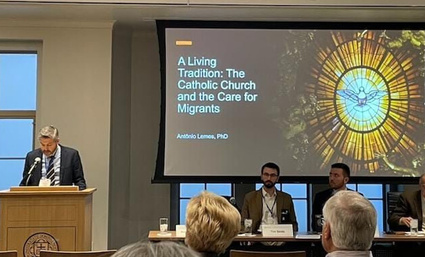
For Antônio Jose Lemos, being a college professor was always part of the plan. Since he was young, he was passionate about marking out his path towards that goal. He wanted to study theology, but he wanted to do it in the very best places to study theology, particularly as a Catholic. After pursuing law studies in his home country, Brazil, he enrolled in the Pontifical Athenaeum Regina Apostolorum in Rome, Italy, and graduated with bachelor’s degrees in philosophy and theology, and then went on to earn his master’s in theology. From there, he started looking into Ph.D. programs. Notre Dame was at the top of his list.
Antônio had his eye on Notre Dame for a few reasons. For starters, it had the exact kind of theology program he was interested in. “One of the things I do in my research is the historical method. So I go back in history and see how theologians dealt with a specific ethical problem and try to apply their ideas toward present issues,” he shares. “Notre Dame happens to be one place that has a very solid historical theology program.” Another point in Notre Dame’s favor is that it’s theology program is consistently ranked the top theology, divinity, and religious studies program globally. Finally, the majority of the theologians doing the most important work in his field were professors at Notre Dame (not to mention, many of the professors at the other university he considered had studied at Notre Dame themselves).
The day he got accepted was one of the happiest days of his life. “I couldn’t sleep—I spent the whole night awake just out of excitement.”
Continuing his research at a Catholic university was especially beneficial, as his research touches on Catholic Social Teaching and Catholic theologians. “My field of theology is moral theology. I deal with ethical problems, social problems.” Specifically, his research examines migration ethics in Catholic social teaching, with a particular focus on the contemporary articulation of the theological and moral principles that serve as the bedrock of migrants’ rights. It asks the question, what does the Catholic Church teach about my migrants’ rights and the migration crisis?
In Notre Dame, he found the ideal setting to pursue his research. “At Notre Dame, you start your Ph.D. program in a community of scholars and researchers. During the first two years, you take coursework in different fields, which opens up your horizons. You have peers working side by side with you with whom you’re sharing your research.” For Antônio, another important part of his education was not just advancing and refining his research, but learning how to teach it. “I want to be a good professor, not just a researcher.” This was another area where Notre Dame excelled—his education included training for how to teach. By providing workshops and actual teaching experiences, students are exposed to teaching early on, as opposed to being thrown into it after they get their Ph.D.
The only problem with Notre Dame? “There are more resources than ideas you can come up with to use them,” says Antônio, jokingly. “I've been to conferences all over the world, and had opportunities to present my paper to scholars...the resources for research are incredible.” He also took opportunities to get involved through fellowships, becoming a fellow at several organizations, including the de Nicola Center for Ethics and Culture, the Jacques Maritain Center, the Nanovic Institute for European Studies, and the Institute for Ethics and the Common Good. “I was blessed to be part of very different institutes as a fellow,” Antônio says, “These were also opportunities of community.”
Last summer, he finished his Ph.D. program and defended his dissertation titled, “The right to travel and dwell in Francisco de Vitoria and Domingo de Soto: a historical retrieval of the right to migrate in Catholic social teaching.” In the fall, he started as a postdoc at Notre Dame. Now, he spends his days both continuing his research and instructing as a teaching scholar in the Department of Theology. “I love teaching. I love engaging with students, and I love sharing my faith through theology…Since I was 18 years old in college in Brazil, I already had the mind to be a college teacher someday. So it's a dream fulfilled in a way.”
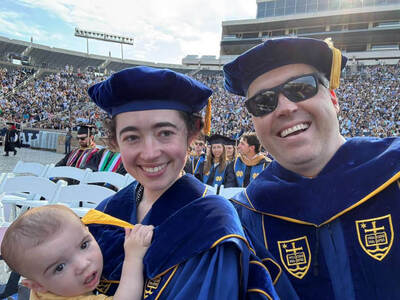
Antônio at graduation with his wife and baby
Noting the growing number of Brazilian students at Notre Dame, the largest population of international students, Antônio shares that it’s particularly special for him to teach Brazilian students. “Knowing that Notre Dame is so engaged with Brazil excites me. Thaïs [Burmeister de Campos Pire] has all kinds of incredible things she’s sharing about Notre Dame in Brazil, and I really appreciate the work she’s doing,” he says, speaking of the Notre Dame São Paulo director.
An especially beautiful part of his journey at Notre Dame, Antônio says, is how many opportunities he’s found here to grow in his faith. As a Catholic, he’s found community on campus through prayer groups, adoration, and programs Campus Ministry puts on. After meeting his wife here, they went through a marriage prep course together that Campus Ministry organized.
Beyond his personal faith life, Notre Dame’s Catholic identity has also impacted his work. “I see the overlap between my faith and my research and my teaching, and I really appreciate this. I cannot take that for granted.” Between publishing papers, receiving fellowships, engaging in community activities, and finding his life partner (and starting his family), it’s clear that Antônio has not taken a single opportunity or experience for granted while at Notre Dame. His is a dream well pursued, and a journey still ongoing.
Originally published by Jessie Carson at saopaulo.nd.edu on May 19, 2026.
]]>
Jessie Carsontag:theology.nd.edu,2005:News/1823232026-05-15T12:08:00-04:002026-06-08T12:55:05-04:00Seven new Research Innovation Collaboratives to begin in 2026-2027
Fourteen scholars will participate in the third round of the Franco Institute’s Research Innovation Collaboratives. These “labs” build on the University’s strategic framework by encouraging research outside of departmental and institutional confines in order to radically reimagine how this work informs, influences, and inspires innovative scholarship. Each collaborative will consist of a group of scholars pursuing a core question (or a small set of closely related questions). Collaboratives will foster research, teaching, and outreach, deepening connections across disciplines and bringing the insights of the liberal arts to public life.
In partnership with three of the university’s Strategic Initiatives, the Franco Institute is funding seven new interdisciplinary collaboratives.
Through a project titled “Archipelagos of Race,” Thomas Anderson, professor of Romance Languages and Literatures, and Xavier Navarro Aquino, assistant professor of English, will investigate the artistic, linguistic, and cultural dimensions of race and ethnicity in the Caribbean through theoretical inquiry and artistic output.
Tatiana Reinoza, associate professor of art history, and history professor Karen Graubart seek to integrate humanities studies to ask broad questions, often related to policy, in their lab titled “Central American Racial Formations.” They believe that integrating humanities-based analysis with questions more commonly addressed through social sciences and policy will produce deeper and more people-centered scholarship and open new paths for understanding social injuries, connectivities, and conflicts.
In “Medieval Roots to Global Networks: Catholic Sisters and the Archive,” Katie Bugyis, associate professor in the Program of Liberal Studies and Director of Postdoctoral Studies, and CJ Jones, Director of the Medieval Institute and professor in the Department of German, Slavic, and Eurasian Studies, draws on archival collections to examine how Catholic women religious communities understood, interpreted, and transmitted their histories as makers of historical knowledge who shaped their own institutional identities through scholarship, pedagogy, and archival practices.
Associate professor of philosophy Therese Cory and theology professor Paulinus Odozor have formed an international working group for their collaborative titled “Vatican II: Renewal within Tradition.” This collaborative works with 150 members engaged in the ongoing interpretation of the second Vatican Council and its significance for the global Church and in regional contexts.
Kathleen Sprows Cummings, Director for the Global Catholic Research Initiative, values the Strategic Initiatives’ partnership with the Franco Institute. “The Global Catholic Research Initiative is proud to partner with the Franco Family Institute in supporting two of this year’s Research Innovation Collaboratives,” Cummings said. She further shared, “By funding ‘From Medieval Roots to Global Networks: Catholic Sisters and the Archive’ and the International Working Group, ‘Vatican II: Renewal within Tradition,’ GCRI is investing in projects that exemplify the global scope, historical depth, and interdisciplinary strength of Notre Dame scholarship.” In sum, Cummings stressed the importance of the Research Innovation Collaboratives’ role in scholarship at Notre Dame. “Together, these collaborations advance the University’s mission to become the preeminent hub for research on global Catholicism,” she said.
William Donahue, professor in the Department of German, Slavic, and Eurasian Studies, will work with Jens Martin of the University of Amsterdam on a project titled “Contested History in Public Spaces: Toward a Global Memory Culture.” Their collaborative re-thinks terminology around public memory to accommodate the challenges around a “memory culture” that functions in dynamic and sometimes unpredictable patterns.
For their collaborative titled “Symphonic Wings Part II: Sustaining Our Common Home through Faith, Science, and Art,” Cynthia Katsarelis, assistant professor of the practice in Sacred Music and Ritornello Chamber Orchestra Director, and Paul Kollman, associate professor of theology, will turn their symphony project Symphonic Wings into a lasting and public-facing platform for thinking about insects through lenses of faith, culture, history, ethics, and care for the living world.
History professor Julia Thomas will partner with Benjamin Goossen, an assistant professor of international history at Boston University, on “Asia and the Anthropocene: Bringing Human Histories and Earth History Together.” Their collaborative approaches the human activity of the Anthropocene from Asian perspectives to address what may be most useful about the Anthropocene as a distinctive framework for Asian histories and what drawbacks to such a framework may exist.
Originally published by Jacob Schepers at franco.nd.edu on May 05, 2026.
]]>
Jacob Scheperstag:theology.nd.edu,2005:News/1823222026-05-08T12:04:00-04:002026-08-04T10:11:12-04:00Eleven scholars named Franco Faculty Fellows for 2026-2027
The Franco Institute is pleased to announce that eleven scholars from the College of Arts & Letters have received faculty fellowships for the 2026-2027 academic year.
The new cohort follows a successful first year of the Franco Humanities Fellows program. This year's cohort includes faculty who received awards through two new programs: the Franco Public Fellowship and the Franco Mid-Career Fellowship.
Franco Humanities Fellows
From left: Liam Kruger, Emily Wang, Emiliano Aguilar, Johannes Junge Ruhland, Xueying Wang, Ijeoma Kola
Humanities Fellowships support full-time research in the humanities by individual faculty in Arts & Letters.
Mid-Career Fellowships support associate and full professors in any discipline in Arts & Letters aiming to develop new skills for a future research project.
Originally published by Jacob Schepers at franco.nd.edu on April 30, 2026.
]]>
Jacob Scheperstag:theology.nd.edu,2005:News/1805482026-03-27T09:09:00-04:002026-04-01T09:10:26-04:00Notre Dame Department of Theology ranked best in the world for second consecutive year
The University of Notre Dame has again been ranked as the world’s best theology, divinity, and religious studies program by the influential QS World University Rankings. This is the second consecutive year and the fifth time since 2020 that the Department of Theology has received the No. 1 distinction.
The ranking is based on academic reputation, employer reputation, and research impact. Out of 150 universities included, Notre Dame’s score of 92.2 bested the University of Oxford (89.2), Harvard University (89.1), Durham University (88.7), and Boston College (88.3).
“To be ranked No. 1 in the world for two years in a row is a momentous accomplishment for which all our faculty and staff deserve great credit,” said Fr. Khaled Anatolios, the John A. O’Brien Professor of Theology and chair of the department. “As a department, we take the measure of our own performance less from external rankings than from fidelity to our mission. Nevertheless, these consistently top rankings demonstrate that our fidelity produces scholarly results that are literally second to none in commanding international admiration.”
In addition to offering a doctorate and four master’s degree programs, Notre Dame’s theology department maintains a strong commitment to undergraduate education by supporting more than 800 theology majors or minors and teaching the theology courses that all Notre Dame students take as part of the University’s Core Curriculum.
Originally published by Arts & Letters at al.nd.edu on March 26, 2026.
]]>
Arts & Letterstag:theology.nd.edu,2005:News/1805472026-03-25T09:11:00-04:002026-04-01T09:11:43-04:00Nineteen scholars research “Attention” through the Franco Institute’s 2025-2026 Annual Research Theme Grants
At the beginning of the current academic year, the Franco Institute launched its sixth annual research theme: “Attention.” In addition to awarding grants to faculty and graduate students, the Institute will host the inaugural Dorothy Day and Thomas Merton Culture and the Public Good Symposium on April 10, 2026, which takes up the attention theme by asking the speakers “How should we hold attention?”
Over the past year, the Institute awarded nineteen Annual Research Theme grants to faculty and graduate students in the College of Arts & Letters. With the Franco Institute’s support, scholars in anthropology; art, art history, and design; English; peace studies; political science; psychology; Romance Languages and Literatures; sociology; the Technology and Digital Studies Program; and theology are researching diverse locales—including Kenya, Brazil, the Philippines, Mexico, Turkey, and Nepal—as well as South Bend.
Six projects deal directly with the so-called “attention economy” and how digital technologies affect and monetize human attention. These projects examine how technology—from TikTok and AI to social media algorithms—actively reshapes, fragments, or undermines attention. Abigail Hemmen, a doctoral candidate in political science, examines how intermingling news headlines with non-news content on social media feeds can trivialize politics. Taking a global perspective, political science and peace studies graduate student Ali Altiok studies how Kenyan youth confront AI-generated political disinformation and deepfakes in order to assess the efficacy of targeted digital literacy education. In a similar vein, Gessica de Freitas, another graduate student in political science, studies how informational overload in Brazil’s complex electoral systems undermines voters’ democratic focus and memory. From a psychological lens, graduate student Lauren Garner investigates the extent to which TikTok may be negatively influencing sustained attention and contrasts those effects with guided meditation practices. Alexi Orchard, an assistant teaching professor in the Technology and Digital Studies Program, proposes that people could seek to emulate generative AI’s capability of processing long text sequences while preserving context. For Orchard, humanities-led expertise can help to develop deep context and evidence-based reasoning rather than accepting superficial or misleading information without much scrutiny. Putting these concerns into practice, associate professor of studio art Jason Lahr translates the “mire of memes” and the experience of “doomscrolling” into the slow, contemplative practice of painting. Lahr is preparing this work for upcoming exhibitions.
Three grantees in psychology focus on the internal mechanics of attention: how it is controlled, how it fails, and how its dysregulation leads to adverse psychological outcomes. Psychology professor Brad Gibson researches whether chronic boredom reflects an impaired voluntary “internal attention” and is developing a model to measure this untested hypothesis. The question of what happens from too much attention is the question that Ryan Carpenter, assistant professor of psychology, seeks to answer. Carpenter explores how an “over-focus on reward” may act as a common link between addiction and nonsuicidal self-injury (NSSI). Psychology graduate student Aurora Roghair investigates the link between environmental lead exposure and ADHD in South Bend-area children. Her study will provide home lead-testing kits to caregivers and her findings can inform community-based screening and early detection.
A few scholars cast attention in terms of its implications for power, justice, and institutions. Their projects treat attention as a political resource and investigate who is granted "regard" and whose suffering is systematically ignored or silenced. The “moral economy of care” within Nepal’s medical system is the focus of anthropology graduate student Prakash B K’s research into clinical attention through twelve months of ethnographic fieldwork. Collective memory and media depictions feature heavily in graduate research from Giulia Maria Gliozzi in Italian Studies and Fabían Díaz Maldonado in sociology. Gliozzi examines how postwar institutions in Italy directed public attention away from specific Holocaust testimonies. Maldonado considers attention within the context of media portrayals, asking how partisan media frame certain social movements to be deemed “worthy” of public attention. Through this work, Gliozzi and Maldonado advance our understanding of attention’s role in conditioning public responses to public memory and collective action.
Other scholars pick up on these themes and investigate attention in relation to memory, resilience, and cultural witness. Communities and their relationship to memory are are the focal point for both Insha Bint Bashir, a graduate student in anthropology, and Jorge Manuel Arredondo Sevilla in theology. Bashir investigates attention as collective infrastructure. Drawing on science and technology studies, her work explores how communities cultivate shared practices of care, documentation, and accountability across sociotechnical systems where data access and preservation remain uneven and uncertain. Sevilla is working on a novel which explores how Indigenous Mexican communities have resisted cultural erasure. Anthropology graduate student Melis Gemalmaz envisions attention as a form of solidarity and a spiritual and ethical practice as it emerged in Antakya, Turkey, after the 2023 earthquakes. She studies how the act of attending to another’s suffering and welfare acquired renewed significance within a crisis.
Some projects consider the narrative potential of attention by examining how attention to objects, art, and storytelling can create meaning and therapeutic outcomes. Tirna Chandra, a graduate student in English, examines attention to objects and materials in narratives by First World War female medical caregivers as a therapeutic tool for trauma. For anthropology graduate student Jeremi Panganiban, physical objects and activities also tell the story of attention. Using photographs, storytelling walks, and community mapping, Panganiban studies how coastal residents in the Philippines use “noticing” to document and navigate ecological and economic transitions from fishing to tourism.
Shifting to visual arts more explicitly, art historian Elyse Speaks researches how sculptors in the 1970s and 1980s combined organic, found, and industrial materials; she argues that these artists use such materials specifically to direct attention to the resulting “entanglements.” In the Department of Romance Languages and Literatures, assistant professor Johannes Ruhland looks at the use of medieval “exempla” in thirteenth-century texts. By analyzing these illustrative anecdotes, Ruhland asks whether the era’s French historians acted as “attention seekers” to teach their audiences how to lead moral lives. Ultimately, these studies demonstrate that such modes of attention are not only about seeing but also about caring, remembering, and acting.
A few notable insights emerged out of these varied research projects. Almost every discipline explicitly viewed attention not only as a mental faculty but also as a finite resource claimed by various platforms and social structures. The scholars draw clear distinctions between “fast” attention (TikTok, deepfakes, and doomscrolling) and “slow” attention (ethnographies, painting, archival research, and meditation). Ultimately, this research suggests that the simple act of “paying attention” to another human is, in itself, a political and ethical act. The Franco Institute is proud to support this work demonstrating the innovative research in the College of Arts & Letters.
Originally published by Jacob Schepers at franco.nd.edu on March 24, 2026.
]]>
Jacob Scheperstag:theology.nd.edu,2005:News/1787072026-01-26T14:09:00-05:002026-01-26T14:09:35-05:00Lilly Endowment makes $5 million grant to Notre Dame to strengthen recruitment and discernment process for future Catholic leaders
The University of Notre Dame has received a $5 million grant from Lilly Endowment Inc. to support a new project aimed at bolstering the talent pipeline for theological leadership within the Catholic Church through the Department of Theology’s Master of Arts and Master of Divinity programs.
Through the department’s initiative, New Horizons: Educating and Forming Tomorrow’s Catholic Leaders, led by Rev. Kevin Grove, C.S.C., an associate professor of theology, Notre Dame seeks to establish a sustainable, collaborative effort to mentor and support emerging Catholic leaders. Over the next five years, the program plans to support 24 students entering the M.A. program and 20 entering the M.Div. program, as well as guiding 100 other individuals through the church leadership discernment process.
In doing so, the program aims to enhance support structures, provide clearer pathways for study and alleviate financial barriers, particularly for promising leaders in underserved communities and mission dioceses. Program leaders hope that this new model will create an opportunity to reshape ministry formation at Notre Dame well beyond the five-year funding period.
“This grant connects Notre Dame’s world-class Department of Theology with leading partners where the Catholic Church is growing and in need of well-formed, dynamic Church leaders,” Grove said. “Together, we will work to recruit, form, educate, support and place these future ministers. We are exceptionally grateful to the Lilly Endowment for providing us the chance to reimagine how lay church leaders are raised up, formed and placed.”
The New Horizons program plans to target highly committed young adult leaders embedded in communities that represent potential future growth for the Church, including through outreach partnerships with the Catholic Extension Society; the Fellowship of Catholic University Students (FOCUS); Iskali, a nonprofit focused on engagement with Latino Catholic young adults; and the dioceses and programs served by Notre Dame's McGrath Institute for Church Life. It will then provide cohort-based discernment opportunities in which participants experience Notre Dame’s M.A. and M.Div. programs as they consider pursuing graduate studies.
New Horizons will provide full tuition support for M.A. students and stipends for M.Div. students, making these programs affordable and accessible, then help participants develop robust networks to facilitate post-graduation job placements.
In addition to Grove, the New Horizons leadership team includes Catherine Cavadini, teaching professor of theology and director of the M.A. program; Kristin Haas, assistant teaching professor and associate director of the program; and Todd Walatka, teaching professor and assistant chair for graduate studies.
The New Horizons program is being funded through Lilly Endowment’s Pathways for Tomorrow Initiative. Launched in 2021, it has provided grants totaling more than $700 million to support theological schools across the United States and Canada as they respond to the most pressing challenges they face while preparing pastoral leaders. The grant to Notre Dame is one of 45 that was approved in this competitive round of funding.
Notre Dame previously received a $7.9 million grant through Pathways for Tomorrow in support of Haciendo Caminos, a partnership with Boston College that includes 16 other Catholic institutions in efforts to identify and form the next generation of pastoral leaders to serve U.S. Catholics, while rooted in the Latino experience.
Lilly Endowment Inc. is a private foundation created in 1937 by J.K. Lilly Sr. and his sons Eli and J.K. Jr. through gifts of stock in their pharmaceutical business, Eli Lilly and Company. While those gifts remain the financial bedrock of the Endowment, it is a separate entity from the company, with a distinct governing board, staff and location. In keeping with the founders’ wishes, the Endowment supports the causes of community development, education and religion and maintains a special commitment to its hometown, Indianapolis, and home state, Indiana. A principal aim of the Endowment’s religion grantmaking is to deepen and enrich the lives of Christians in the United States, primarily by seeking out and supporting efforts that enhance the vitality of congregations and strengthen the pastoral and lay leadership of Christian communities. The Endowment also seeks to improve public understanding of diverse religious traditions by supporting fair and accurate portrayals of the role religion plays in the United States and across the globe.
Contact: Carrie Gates, associate director of media relations, c.gates@nd.edu or 574-993-9220
Originally published by Josh Weinhold at news.nd.edu on January 23, 2026.
]]>
Josh Weinholdtag:theology.nd.edu,2005:News/1771792025-12-10T09:41:00-05:002026-01-06T13:53:05-05:00Liturgical scholar examines how, across centuries, physical manuscripts can influence and shape faithInnocent Smith, O.P., joined Notre Dame's Department of Theology as an assistant professor. His work centers on the historical interconnection between the law of prayer (lex orandi) and the law of belief (lex credendi), the principle that the way Christians worship forms their beliefs. (Photo by Jon L. Hendricks/University of Notre Dame)
Innocent Smith, O.P., feels perfectly at home among the colorful bindings that line the Medieval Institute Library on the seventh floor of the University of Notre Dame’s Hesburgh Library. Books aren’t just how he does his research — they’re the subject of his research, as well.
As a Dominican priest, Fr. Smith views liturgy not merely as a ritual, but as a profound and tangible intersection of heaven and earth, drawing on art, music, and the full spectrum of human expression. Liturgy — the public, communal act of worship and sacrament in the Catholic Church — “takes in everything that it means to be human, as well as everything that God wants to reveal to us,” he said.
That theological conviction forms the bedrock of his scholarly focus — the history of medieval liturgical books.
Fr. Smith joined the Department of Theology as an assistant professor this year, after teaching at the Pontifical Faculty of the Immaculate Conception in Washington, D.C., and St. Mary’s Seminary and University in Baltimore. His intellectual journey began at Notre Dame as an undergraduate studying music and philosophy, continued when he entered the Order of Preachers after graduation in 2008 and was ordained a priest in 2015, then furthered when he completed his Ph.D. at the University of Regensburg in Germany.
“Looking back on my time in seminary, pastoral ministry, and doctoral studies, I have been blessed to experience a fruitful intersection of study, prayer, and ministry,” he said. “Celebrating the liturgy inspires me to try to understand the history and theology of the liturgy more deeply, and my research has often enabled me to come to the liturgy with a renewed understanding of the mysteries of the Church.”
His work centers on the historical interconnection between the law of prayer (lex orandi) and the law of belief (lex credendi), the principle that the way Christians worship forms their beliefs. He studies historical examples of how Christian worship traditions have dynamically influenced theological understanding, demonstrating that this interaction is not a niche topic but a universal process that every Christian participates in.
A key example of this is found in his current study of St. Thomas Aquinas, who is often mischaracterized as a purely abstract, reason-driven thinker. Fr. Smith’s research, however, reveals how deeply liturgical the theologian’s entire life and work truly was. He has found evidence that Aquinas’ idea of who God is — particularly as a merciful being — is profoundly shaped by his liturgical experience, as he repeatedly quotes liturgical prayers about God’s mercy throughout his texts.
“The way we pray influences how we believe, and the way we believe influences how we pray,” he said.
An object and an instrument
Fr. Smith’s method for answering this central question is intensely material and interdisciplinary. Fr. Smith specializes in the history of liturgical books, including missals and medieval manuscripts, and how their physical structure and artistic composition contribute to their theological content.
He is fascinated by the book as a whole entity, moving beyond the traditional scholarly tendency to study text, art, or physicality in isolation.
“I’m interested in how all of these things fit together, how the book is an object as well as, in a sense, an instrument,” Fr. Smith said.
His doctoral research and monograph, for example, focused on the “Bible missal” — a type of book that combined texts for Mass with biblical texts — illuminating how profoundly biblical the liturgy of the Middle Ages was. He argues that the complementary nature of the liturgical and scriptural texts within those manuscripts “underscores the deep continuity between scriptural revelation and the sacraments of the Church.”
“One thing I want to do is to empower the students to pursue their own research and their own interests in a way that is academically serious."
That research emphasis directly informs his teaching. In his doctoral seminar on medieval liturgy, Fr. Smith brings graduate students into the Hesburgh Libraries’ Rare Books & Special Collections to pore over original medieval manuscripts. He emphasizes that this hands-on study is crucial and reinforces the concept that liturgy is central to the Church's historical worship and self-understanding.
By interacting with the physical manuscripts, Fr. Smith believes, students can appreciate the integrated beauty of the books and ultimately interpret critical editions and digital facsimiles more responsibly.
“One thing I want to do is to empower the students to pursue their own research and their own interests in a way that is academically serious,” he said.
Notre Dame provides the ideal environment to propel Fr. Smith’s research forward by offering unparalleled resources and a unique sense of institutional continuity. His early love for liturgical studies — specifically medieval chant — was fostered at Notre Dame, and he was particularly inspired by professors Calvin Bower, Alexander Blachly, and Sabine MacCormack.
Today, working alongside some of these same scholars, he is diving deeper into the Gregorian tradition — a well-researched and practiced area in the Sacred Music at Notre Dame program.
“Singing Gregorian chant allows for a kind of meditation on the words of scripture in a very intense way, and sometimes the musical elements will bring out hidden depths of the texts themselves,” Fr. Smith said.
He also examines the broader cultural impact of this music tradition by highlighting potential connections between the liturgical practice of song and the early development of opera in Western culture.
A renewal and an inspiration
Innocent Smith, O.P., feels perfectly at home among the colorful bindings that line the Medieval Institute Library on the seventh floor of the University of Notre Dame’s Hesburgh Library. (Photo by Jon L. Hendricks/University of Notre Dame)
Beyond the academic collaboration, Fr. Smith’s return highlights the University's long-standing support. As an undergraduate discerning his vocation, Notre Dame provided crucial research grants to study early manuscripts in Philadelphia and Rome — experiences that laid the groundwork for his Dominican priesthood and academic career.
He plans to continue this legacy and foster a learning environment in which students can pursue their own deeply rooted interests.
“All of my personal life as a Dominican friar and my academic work as a professor really merge in this celebration of the liturgy and the study of it,” he said.
Fr. Smith hopes his ongoing work will shed light on how the Church’s diverse liturgical traditions continue to shape contemporary faith. He acknowledges that history alone cannot solve modern problems, but it can provide vital resources and inspiration for current debates.
“The study of the past can be a source of renewal, as well as a source of inspiration,” he said. “It’s not just a matter of restoring some ideal past, but rather we take inspiration from a variety of sources and figure out what is appropriate today.”
Liturgy has both a past and a future, and by studying the diversity of medieval liturgical practices, Fr. Smith hopes his work will help show the creative dynamic between tradition and innovation that has characterized every era of growth in the Church's life.
“There’s a beautiful line in the Catechism of the Catholic Church,” he said, “about how there are different forms of liturgy because no single form of the liturgy can exhaust the entire mystery of Christ.”
Originally published by Joy Noel Lightcap at al.nd.edu on December 08, 2025.
]]>
Joy Noel Lightcaptag:theology.nd.edu,2005:News/1771402025-12-09T09:41:00-05:002025-12-09T09:41:57-05:00Theology and pre-health major’s exploration of wide-ranging interests leads him deep into space ethicsJoseph Truluck, who is majoring in theology and Arts & Letters pre-health, stands in the chapel of Geddes Hall. Pursuing a liturgical music ministry minor, the Notre Dame senior shares his musical talent and his faith through the Notre Dame Folk Choir and Voices of Faith. (Photo by Jon L. Hendricks/University of Notre Dame)
Classes in the College of Arts & Letters are known for posing profound questions, from “How do I live a good life?” to “Do I have free will?”
But the course Space Ethics: Creation, Commerce, Colonization asks a question that some could argue is the most essential: “What’s the best science fiction franchise?”
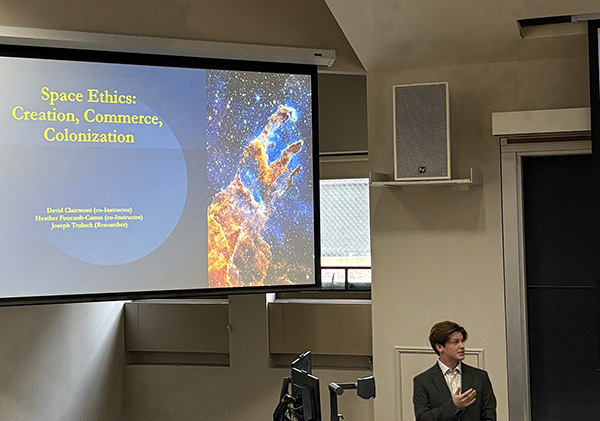
If not academically imperative, the question is at least invigorating, and it helps students immediately begin considering the course’s deeper themes. Taught by David Clairmont, an associate professor of theology, and Heather Foucault-Camm, who directs the Science & Religion Initiative at the McGrath Institute for Church Life, Space Ethics explores issues stemming from the many facets of space exploration, including theological understandings of space’s origins and how and if space should be colonized.
By combining theology and science, the class takes students beyond traditional conceptions of outer space.
“Legal documents and other research are showing a progression in our potential use of space,” said Notre Dame senior Joseph Truluck. “So it’s especially important now that we can say why — morally, theologically — space is good.”
But its subject matter isn’t the only thing that makes Space Ethics special; it’s also who’s behind the scenes.
Truluck, a theology and Arts & Letters pre-health major with a minor in liturgical music ministry, played a crucial role in the development of the Space Ethics course. After aiding Clairmont with a research project in his sophomore year, Truluck was recruited to help organize the syllabus and the reading list for the new class. He’s also working with Clairmont and Foucault-Camm to co-author a paper on space ethics and Catholic social teaching, expanding on the concepts taught in the class.
Space ethics research doesn’t directly connect with Truluck’s prospective career in pediatrics, but for him, college isn’t just about his future job. It’s a place to explore all interests — and in his case, that’s meant singing in the Notre Dame Folk Choir, volunteering with children with special needs … and also Star Wars.
“It’s really important to pursue all of your passions,” he said. “Your extracurriculars should lead to your personal development, and if you’re not passionate about them, they won’t.”
Space as theology’s next frontier
The general topic of space ethics isn’t new territory; conversations about space exploration have been ongoing since the 1960s. But the resulting legal regulations and ethical frameworks have largely focused on the governance and commercialization of space.
“They’ve looked at it in a very consequentialist manner,” Truluck said. “There really haven’t been many theological, moral, and normative considerations.”
Truluck, Clairmont, and Foucault-Camm are now contemplating duty-based space ethics, considering the inherent goodness in space and asking why people might go to space without capitalistic motivations.
Joseph Truluck assists in the Space Ethics course as a researcher. Photo provided.
Their paper will tackle this complex topic in four parts, starting with an overview of the existing legal and ethical considerations coming from secular thinkers. The second part will illustrate the theological creation of space, and the third will examine human activity in space — especially commerce and colonization — through the lens of theology. The fourth will be a more hypothetical consideration of what the next steps may be.
“We’re in space — what now?” Truluck said.
Truluck is focusing on the third section, specifically the medical side of human space activity. This involves consideration of the human body’s capacity for long-term survival in space, as well as concerns around procreation.
Research has shown that low-gravity conditions can make conception difficult in space, which raises concerns about cryopreservation — freezing human embryos and transporting them to space. This is a potential solution to a significant barrier of space colonization, but with Catholicism and moral theology in the picture, it has many flaws.
Addressing the friction between secular science and theological principles is one of Truluck’s key responsibilities in co-authoring the paper. But he doesn’t see science and theology as in opposition to each other — he uses theology as a way to more deeply engage with science.
“Theology allows you to look at nature and investigate something deeper about the essence of God,” he said. “How can we look at space — something that we really haven’t touched yet in theology — and see God in it?”
‘Called to help others’
Truluck views his research experience as a major cornerstone of his continually maturing relationship with theology. Where he’s found the most fulfillment in his nearly four years at Notre Dame, though, has been in service, specifically to people with disabilities.
Since his sophomore year, Truluck has volunteered at A Rosie Place, a respite care home for medically fragile children, where he spends around two hours a week playing with nonverbal children. He also spent a summer as a counselor at Camp Millhouse, which provides a traditional summer camp experience for people of all ages with disabilities.
“I am called to help others, to show others that there’s a gift of love that’s given to each of us.”
This year, he became president of the Special Olympics of Notre Dame. The club partners Notre Dame students and people with disabilities to learn and compete in sports, often working with the University’s varsity athletic programs.
“Special Olympics has totally changed the way that I view the human person,” he said. “People with disabilities, though they might function differently from others, are still just as loved and deserve loving to reaffirm their dignity.”
This belief guides his journey toward a career as a pediatrician for children with disabilities, and it’s also why he’s in the College of Arts & Letters. Truluck started at Notre Dame on the science-heavy track of the neuroscience and behavior major, but he quickly realized that while that degree would lead him to the correct destination, it wasn’t the path he wanted to take.
In his second semester, Truluck took both Introductory Psychology and Faith and Human Flourishing, which provided two distinct portraits of humanity. The psychology class, while providing essential information, seemed disconnected from how he saw the human person, he said. On the other hand, the theology class helped him connect with the principles behind human flourishing — things he’d been exposed to in his Catholic childhood but didn’t fully understand.
“That class was just overwhelmingly like, ‘This is exactly the kind of person I want to be, and it’s the sort of ministry I want to have when I become a doctor,” he said.
For Truluck, incorporating theology with his career preparation is almost a matter of survival, as the medical field — especially pediatrics — has unusually high burnout rates. Watching children go through traumatic experiences is extremely difficult, but Truluck said he is determined to persevere by focusing on what he believes he is meant to do.
“I am called to help others, to show others that there’s a gift of love that’s given to each of us,” he said. “If I can contribute to that system, I feel that my heart is completely fulfilled.”
Originally published by Adah McMillan at al.nd.edu on November 21, 2025.
]]>
Adah McMillantag:theology.nd.edu,2005:News/1771382025-12-09T09:33:00-05:002025-12-09T09:33:18-05:00Notre Dame Faculty Contribute to Dialogue on Artificial Intelligence at the Vatican
Fifty global experts gathered at the Vatican's historic Casina Pio IV on October 16–17 to explore how artificial intelligence can advance peace, social justice, and human dignity.
The conference, “Digital Rerum Novarum: Artificial Intelligence for Peace, Social Justice, and Integral Human Development," was co-sponsored by Notre Dame Law School and the Pontifical Academy of Social Sciences (PASS). It brought together theologians, philosophers, economists, social scientists, technologists, and policymakers to analyze AI's opportunities and risks.
The University of Notre Dame had a significant and multidisciplinary presence at the gathering, with faculty from the Law School, College of Arts & Letters, College of Engineering, and Keough School of Global Affairs contributing as organizers, panelists, and discussants.
Through a variety of sessions, participants explored the most effective ways to ensure that emerging digital culture remains truly human–characterized by authentic encounter, care for the vulnerable, and respect for human dignity–through open dialogue on spiritual, ethical, legal, political, sociological, economic, and cultural dimensions of AI.
Professor Lisa Schirch
Aligned with the Catholic Church’s 2025 Jubilee Year and the PASS’s commitment to social justice and integral human development, the seminar reflected on the calls of the late Pope Francis, and recently Pope Leo XIV to steer artificial intelligence toward human-centered ends.
Drawing on Catholic social thought, the seminar centered on four major themes: Catholic Social Teaching in the Age of AI; Global Governance and AI Regulation; AI for a New Era of Social Harmony; and AI, Work, and Integral Ecology. Participants examined how artificial intelligence can advance peace, justice, and human dignity.
Discussions included the emergence of a de facto AI arms race and the respective roles of national and international governance structures. They also discussed equitable access, environmental sustainability, and the ethical use of data, with particular attention to protecting the most vulnerable. Speakers emphasized that human beings must always retain final authority over the use and governance of AI.
Professor Paolo Carozza
Notre Dame Law School Professor Paolo Carozza, also a member of PASS, served as a principal organizer of the seminar and delivered opening remarks, along with Cardinal Peter Turkson, Chancellor of PASS, and Sister Helen Alford, O.P., President of PASS.
Notre Dame faculty participants included:
Paolo Carozza, Professor of Law at Notre Dame Law School, Concurrent Professor of Political Science in the College of Arts and Letters, and a faculty fellow of the Kellogg Institute for International Studies Panels on AI for Integral Human Development and Towards International Standards and Governance for Responsible AI (chair)
Nitesh Chawla, Frank M. Freimann Professor of Computer Science and Engineering in the College of Engineering, founding director, Lucy Family Institute for Data & Society and Lucy Family Director for Data and AI Academic Strategy, University of Notre Dame Panel on Sustainable AI
Perla Khattar, Doctorate of Juridical Sciences Candidate at Notre Dame Law School and IBM Research Extern
Mary Ellen O’Connell, Robert & Marion Short Professor of Law at Notre Dame Law School and Concurrent Professor of International Peace Studies in the Kroc Institute for International Peace Studies in the Keough School of Global Affairs Panel on Governing the Risks of AI as a Weapon
Brett Savoie, Coyle Mission Collegiate Professor of Engineering, Chemical and Biomolecular Engineering in the College of Engineering
Paul Scherz, Our Lady of Guadalupe Professor of Theology in the College of Arts and Letters Panel on AI and Cognitive Integrity
Lisa Schirch, Richard G. Starmann, Sr. Professor of the Practice of Peace Studies in the Keough School of Global Affairs Panel on Social Peace in Digital Networks
O. Carter Snead, Charles E. Rice Professor of Law at Notre Dame Law School Panel on AI and Cognitive Integrity
Tim Weninger, Associate Professor, Computer Science and Engineering in the College of Engineering Panel on Social Peace in Digital Networks
Professor Nitesh Chawla
An outcome of the seminar was the establishment of the Latin American AI Network for Integral Human Development, a cross-institutional effort to foster collaboration on AI development. The network will meet to exchange knowledge and will encourage broad regional participation.
Read reflections and key takeaways from some of the conference participants below.
Paolo Carozza, Professor of Law at Notre Dame Law School, Concurrent Professor of Political Science in the College of Arts and Letters, and a faculty fellow of the Kellogg Institute for International Studies
“The important role and responsibility that the University of Notre Dame as a whole has in this area was very evident at the seminar, where our faculty members from various disciplines contributed key insights from their expertise. In that collaboration, Notre Dame has a unique capacity to generate deep ethical reflection, consistent with the Catholic social tradition, on the challenges of AI.”
Nitesh Chawla, Frank M. Freimann Professor of Computer Science and Engineering in the College of Engineering, founding director, Lucy Family Institute for Data & Society and Lucy Family Director for Data and AI Academic Strategy, University of Notre Dame
"Gathering at the Vatican highlighted the Catholic Church’s universal embrace of diverse peoples and disciplines in pursuit of the common good. The conference offered a deeply meaningful opportunity to reflect on a plurality of perspectives as we considered how AI can promote peace, social justice, and integral human development."
Perla Khattar, Doctorate of Juridical Sciences Candidate at Notre Dame Law School and IBM Research Extern
“Working on the organization of the Digital Rerum Novarum conference was an intellectually transformative experience. For the first time, I was invited to look at artificial intelligence and technology through the lens of human dignity and the human person—a perspective deeply rooted in Catholic social thought and one that is urgently needed in today’s fast-evolving technology industry. One of my favorite parts of the process was tracing Pope Leo XIV’s speeches and publications on artificial intelligence since the beginning of his pontificate to better understand how his engagement with artificial intelligence consistently centers the human person. Bringing together scholars, theologians, technologists, and policymakers under the umbrella of Notre Dame’s deep academic and ethical tradition was a rare opportunity to foster genuine interdisciplinary dialogue at the Vatican.”
Mary Ellen O’Connell, Robert & Marion Short Professor of Law at Notre Dame Law School and Concurrent Professor of International Peace Studies in the Kroc Institute for International Peace Studies in the Keough School of Global Affairs
“In the shadow of St. Peter's, my argument for preserving peace, human rights and the natural environment by adapting AI from offensive military uses to defense found new receptivity. The Vatican is fostering the answers to the planet-ending, humanity-ending potential of AI.”
Brett Savoie,Coyle Mission Collegiate Professor of Chemical and Biomolecular Engineering; Director of the University of Notre Dame Scientific Artificial Intelligence Initiative
“The distinctive depth of Notre Dame expertise was on full display at the Digital Rerum Novarum conference. AI is not one thing, it is many things and yet the university was able to respond to the Pontifical Academy’s call for experts at this important forum.”
Paul Scherz, Our Lady of Guadalupe Professor of Theology in the College of Arts and Letters
"The conference was a great opportunity to bring theological reflections on the Church's anthropological and social teachings into dialogue with other disciplines like law and computer science as the Church attempts to confront the challenges and opportunities of the rapid development of AI."
Lisa Schirch, Richard G. Starmann, Sr. Professor of the Practice of Peace Studies in the Keough School of Global Affairs
"Catholic Social Teaching is deeply relevant to AI, a tool that could revitalize democracy through large-scale public deliberation on issues like climate and immigration—but also poses serious risks to undermine it."
O. Carter Snead, Charles E. Rice Professor of Law at Notre Dame Law School
"It was a great honor to join my Notre Dame colleagues in this important interdisciplinary opportunity at the Vatican to take up the challenge posed by the Holy Father to think together about how to ensure that AI is developed in a way that respects human dignity and serves the common good. For my part, I brought the insights from my work in bioethics and made the case that an anthropology of embodiment offers a useful framework for the protection of persons and promotion of human flourishing (through love and friendship) in this fraught domain."
Tim Weninger, Associate Professor, Computer Science and Engineering in the College of Engineering
“Artificial Intelligence is transforming how we perceive the world; it's changing the ways that we interact with and talk to one another," said Tim Weninger, associate professor of Computer Science and Engineering. "It is important for foundational institutions like the Catholic Church to step up to provide moral guidance in a world profoundly changed by this impactful technology. Our goal is to help in that endeavor and I believe we're making great progress."
Originally published by Notre Dame Law School at law.nd.edu on November 17, 2025.
]]>
Notre Dame Law Schooltag:theology.nd.edu,2005:News/1822152025-11-17T13:12:00-05:002026-06-01T13:32:05-04:00Khaled Anatolios Speaks at Receiving Nicaea Conference 2025, Pusey House Oxford
Pusey House, Oxford hosted the Receiving Nicaea conference on 12–13 November 2025 in memory of Betsy Livingstone. Marking the 1700th anniversary of the Council of Nicaea (AD 325), the gathering brought together scholars and clergy to examine the Council as a pivotal moment in the Christianisation of the Roman Empire and a major stage in the development of orthodox Christian doctrine.
A central figure among the presenters was Rev. Prof. Khaled Anatolios, Senior Ecumenical Fellow and John A. O’Brien Professor of Theology and Chair of the Department of Theology at the University of Notre Dame. The conference featured a distinguished group of speakers, including the Rt. Revd. and Rt. Honorable Rowan Williams, Emeritus Archbishop of Canterbury. The conference also included the celebration of Evensong, at which Fr. Anatolios was the preacher and incorporated a performance of the Symbolum Nicenum (Credo) from Bach’s Mass in B Minor BWV 232.
The event explored the reception of Nicaea throughout the Church’s history and considered the continuing significance of the Council’s doctrinal formulae in both theological study and the spiritual life of the Church. Focus was given to how saying and praying the Creed shapes the life of the Church, informs the Christian’s experience of God, and equips the Church to meet present-day challenges.
]]>
Theology Departmenttag:theology.nd.edu,2005:News/1822172025-11-10T13:26:00-05:002026-06-01T13:26:39-04:00Fr. Khaled Anatolios Speaks at the Anglican Cathedral of All Saints in Albany, NY
As part of a joint celebration by the Anglican Cathedral of All Saints and the Cathedral of the Immaculate Conception in Albany, New York, a special gathering was held on Saturday, November 1, 2025, where Fr. Khaled Anatolios delivered the keynote address for the annual Bible Symposium commemorating the 1700th anniversary of the Nicene Creed.
The symposium took place at the Anglican cathedral and brought together clergy, scholars, and lay participants from across the region. Fr. Anatolios— Senior Ecumenical Fellow of the Tantur Ecumenical Institute and John A. O’Brien Professor of Theology and Department Chair at the University of Notre Dame— offered an in-depth exploration of the Biblical foundations, historical formation, and enduring significance of the Nicene Creed.
Additionally, Fr. Anatolios delivered the Sunday morning homily at the Cathedral of the Immaculate Conception and preached at the Evensong service on Sunday afternoon at the Anglican Cathedral of All Saints.
The event was co-sponsored by a diverse ecumenical group, including the Episcopal Diocese of Albany, the Roman Catholic Diocese of Albany, Siena College, and the New Skete Monasteries, reflecting a shared commitment to theological engagement across Christian communities.
Overall, the gathering was remembered as a rich weekend of teaching, ecumenical fellowship, and liturgical prayer.
]]>
Theology Departmenttag:theology.nd.edu,2005:News/1751922025-10-23T08:36:00-04:002025-10-23T08:36:34-04:00Two summers, one calling: Theology senior Ty Harrington's path back to India
When a place welcomes you once, it has a way of calling you back. For Ty Harrington ’26—a program of liberal studies (PLS), philosophy, and theology major from Carmel, IN—that place was India. His first visit came through an Institute for Social Concerns fellowship at Govardhan Ecovillage (GEV), where he spent eight weeks studying the intersection of Indian philosophy, spirituality, and care for the earth. A year later, he returned to Mumbai to assist Rev. Mark Poorman, C.S.C., on a faculty research project. What began as a quiet summer in an ashram unfolded into a return journey that reshaped his perspective on faith, learning, and the wider world.
View of the Sahyadri Mountains from GEV, captured by Ty
A rejuvenating rhythm
Harrington still speaks with fondness about that first trip, which took him to GEV located in the Palghar district in the Sahyadri Mountains, a tranquil area about two and a half hours northeast of Mumbai. “It was an amazing opportunity to be in a beautiful place with wonderful people,” he said. Life at the ashram unfolded at a slower pace. “There was a feeling of calmness alongside streams of intellectual nourishment from the research and conversations. That balance created a very nice and rejuvenating rhythm of life.”
His project, supported by the Institute for Social Concerns, explored how Indian religious traditions form a philosophy of the earth. Immersed in an ISKCON community, he spent long days reading, interviewing, writing, and reflecting. The experience allowed him to produce a thoughtful humanities research paper, in addition to expanding his perspective and strengthening his Catholic faith.
An unexpected invitation
The following spring, an email from one of his professors changed Harrington’s summer plans. “I was shocked and found it hard to believe,” he recalled. “When I left India, I knew I wanted to come back, especially to Govardhan Ecovillage, but I thought it would be a long time. What are the chances that two of my summers at Notre Dame would be spent partially in India?”
This second opportunity brought him to Mumbai as an undergraduate research assistant on a high-profile faculty project examining the moral challenges that Catholic universities face around the world. Harrington joined Father Poorman at St. Xavier’s College to listen to students, faculty, and administrators and to explore how Catholic identity takes root in a global, multi-faith city.
Days in Mumbai were full but purposeful. “We’d wake up, have breakfast, then spend five or six hours interviewing people on campus,” Harrington said. Breaks were brief, but he enjoyed walking through the college’s stone courtyards and chatting with students between sessions. Two conversations stand out: meeting the rector, Rev. Keith D’Souza, S.J., and speaking with a young Jesuit professor. “From a research perspective, those were fascinating,” he reflected, “but what stayed with me was how fortunate I felt to sit face-to-face with people from a completely different context about issues that matter deeply to both of us.”
The courtyard of the historic St. Xavier's College, where Ty and Fr. Poorman conducted their research
A city of scale and spirit
The contrast between a remote ashram and bustling Mumbai gave Harrington a new appreciation for India’s complexity. “Being right in the center of the action gave me a new perspective on the immensity of India and its incredible diversity,” he said. “Mumbai feels like a convergence of so many stories, cultures, and histories.”
The experience also enriched his faith. “Studying Indian philosophy and spirituality strengthened my Catholic faith,” Harrington noted. “Seeing the correlations and parallels between traditions gave me a lot of faith. Both trips gave me perspective and helped me see my own systems of thought in a more contextualized light.”
Relationships built across two summers remain at the heart of Harrington’s memories. At Govardhan Ecovillage, he formed a close friendship with Mohan, a monk who guided the Notre Dame group. “That friendship means a lot to me,” Harrington said. “I never thought I would be able to reconnect so soon, but I visited him again this summer.” In Mumbai, a dinner with the Jesuit community at St. Xavier’s offered another moment of genuine welcome and conversation that he will carry forward.
Advice for fellow students
Ty with his friend Mohan, a monk at GEV, whom he visited during his return to India
Harrington encourages classmates to approach India with intention and openness. “Reflect deeply on why you want to go,” he advised. “It is an intense adjustment and will require periods of adaptation. If you decide to go, be radically open. Do not treat it like a box to check. Go because you believe India has something to teach you, and you are willing to listen.”
He also urges students in the humanities to look toward India’s intellectual heritage. “India has such a rich tradition in philosophy and religion,” he said. “Thinking about the trajectory of world thought, India plays a primary role. There is so much to learn.”
Notre Dame’s presence in Mumbai continues to grow, with opportunities that range from summer and semester study abroad to Global Professional Experience internships, ND Bridge immersive experiences, ISC summer fellowships, and faculty-mentored research. Harrington’s two summers show what is possible when curiosity meets opportunity: one conversation leads to another, and one journey opens the door to a second.
“You discover your context is not the only context,” Harrington reflected. “That expands your heart and your mind.”
Editor’s note: For the backstory on Harrington’s first summer, see our earlier feature on his Govardhan Ecovillage fellowship.
Originally published by Hayden Mascarenhas at mumbai.nd.edu on September 16, 2025.
]]>
Hayden Mascarenhastag:theology.nd.edu,2005:News/1756802025-10-15T14:45:00-04:002025-10-15T14:45:13-04:00MTS graduate Evan Gage ('19) featured in Notre Dame Magazine: "The Gatherer"
In the Autumn 2025 issue of Notre Dame Magazine, "The Gatherer" gives a snapshot of the journey of Evan Gage, MTS '19. Initially led by his interest in Turkey, and formed by his graduate studies and various experiences, he later decided to open a business centered around Turkish rugs and community.
“There are things in here I only understand because of my education,” he says. “People know I’m not just a reseller — I care deeply about this stuff. I feel a sense of responsibility for the history behind these goods. That’s not something I’d have if I hadn’t studied theology at Notre Dame.”
]]>
Kristin Soukuptag:theology.nd.edu,2005:News/1738602025-07-16T14:53:00-04:002025-07-16T14:53:07-04:00Political theorist and Dead Sea Scrolls scholar each win NEH grants to further their research
Two faculty members in the College of Arts & Letters have won competitive National Endowment for the Humanities grants that support their respective scholarly projects.
Eileen Hunt, a professor of political science, was awarded a Scholarly Editions and Translations grant to produce the first academic book that integrates and contextualizes 18th-century author Mary Wollstonecraft’s two visionary treatises that advocate for human rights for all.
The $37.5 million in NEH grants that were announced in late August support 240 humanities projects across the country.
In the announcement, NEH chair Shelly C. Lowe said she looked forward to the resulting products, discoveries, tools, and programs that will “contribute to our greater understanding of the human endeavor and add to our nation’s wealth of educational and cultural resources.”
A career transformation
Hunt, a political theorist, and Nancy Johnson, a SUNY New Paltz associate dean and English professor, will annotate and track variations in different editions of the British philosopher Wollstonecraft’s interrelated books, A Vindication of the Rights of Men (1790) and A Vindication of the Rights of Woman (1792).
Eileen Hunt
The researchers’ work — which will provide social, political, literary, and biographical context about the treatises’ origins, development, significance, and impacts — will compose Vol. 4 in Oxford University Press’ six volume Collected Works of Mary Wollstonecraft.
The goal, Hunt said, is to ensure that Wollstonecraft’s theories about human rights, democracy, and women’s education and citizenship can continue to inform interdisciplinary scholarship.
Hunt said she is excited to do much of the project at Notre Dame, including using digital humanities technology to transcribe first and second editions of the treatises acquired by Hesburgh Libraries’ Rare Books & Special Collections.
“This project has literally been career-transformative for me,” Hunt said. “I’m forever grateful to the University and the NEH.”
Wollstonecraft advocated for the rights of everyone — including women, people who were enslaved, children, people in all economic classes, and other historically oppressed and marginalized people.
“And yet, she also takes time to sympathize with the aristocracy of the time, whom she sees as morally corrupt,” said Hunt, a concurrent faculty member in the Gender Studies Program. “But she also sees them in need of liberation from the chains of the aristocratic culture which had made them sink so low from a moral perspective.”
A timely lesson
Wollstonecraft also has had a tremendous impact on literature, both through her own writing and the work of her daughter, Mary Shelley, the author of Frankenstein (1818). In A Vindication of Rights of Men, for instance, Wollstonecraft argued the aristocratic class system could turn people into monsters.
“This is, in some ways, a premise of her daughter’s novel Frankenstein,” Hunt said. “That the Creature was not born a monster, but was made one, in particular, by the lack of love, care, and benevolent education from his father/scientist and in the broader society.”
Hunt said Wollstonecraft’s arguments in favor of constitutional democracy are particularly pertinent right now, and that understanding her as a thinker provides insight into how to preserve and advance its principles.
“Our current presidential election is, according to many, the most pivotal election of all time. In some ways, the question is whether we’re going to continue with constitutional democracy, rooted in the written law, or whether we’re going to move toward something populist and fascist,” she said. “That’s one reason why, when we wrote this NEH application, we emphasized the relevance of Mary Wollstonecraft to the future of constitutional democracy itself.”
"I'm grateful that Notre Dame has a culture of encouraging faculty to apply for these prestigious grants.”
“It took us two grant cycles to win. Josh encouraged us to try again, and I’m so glad that he did,” Hunt said. “From this process, I learned to never give up and to listen to the advice of the reviewers. I'm grateful that Notre Dame has a culture of encouraging faculty to apply for these prestigious grants.”
Machiela to organize and host conferences on the Aramaic Dead Sea Scrolls
Machiela and Holm, an associate professor of Jewish studies and classics and ancient Mediterranean studies at Penn State, will plan two workshops centered on “The Aramaic Dead Sea Scrolls at the Crossroads of Empire: Negotiating Jewish Life Under Foreign Rule.” The workshops will bring together scholars of the ancient world from 13 leading universities representing six different countries.
Scheduled to occur at Notre Dame in the summer of 2025 and at the Ludwig Maximilian University of Munich in the spring of 2026, the workshops will focus on how Jews thought about their place among the imperial cultures of the ancient Near East. The ancient Jewish scrolls from the Judean Desert provide a window into this period.
Daniel Machiela
"The Bible tells of Israel's exile at the hands of the Assyrians and Babylonians, which provoked a whole new way of thinking about Israel in relation to other nations. The Aramaic scrolls that we will study were originally composed a century or more after the biblical events of exile took place, and wrestle with how to follow God and lead a righteous life while living under the hugely powerful foreign empires of Persia and Greece," Machiela said. "Most of the texts we will discuss reemerged only with the discovery of the Dead Sea Scrolls in the 1940s and 1950s, and their publication after 2000."
Machiela examines how the understudied Aramaic scrolls reinterpret parts of the Old Testament, providing insight into how the biblical text was understood and taught around the turn of the Common Era.
One lesson from the scrolls is that the basic concerns of the Jews who wrote them more than 2,000 years ago were not so different from the concerns of some people of faith today.
“We live in a globalized society where many cultures are crashing together at all times,” he said. “For people of faith who claim the Bible as an important part of their identity, it's often difficult to navigate how that relates to the complex world we're also part of just as human beings today. That same problem — how to relate the past to the present and faith to a broader culture in which many faiths were competing — was a critical issue for whoever wrote these scrolls.”
Originally published by Beth Staples at al.nd.edu on September 25, 2024.